Amir Simon · 2 October 2026
Urban Enrollment Patterns Shift as Poland Expands Hybrid Training Options in Secondary Schools
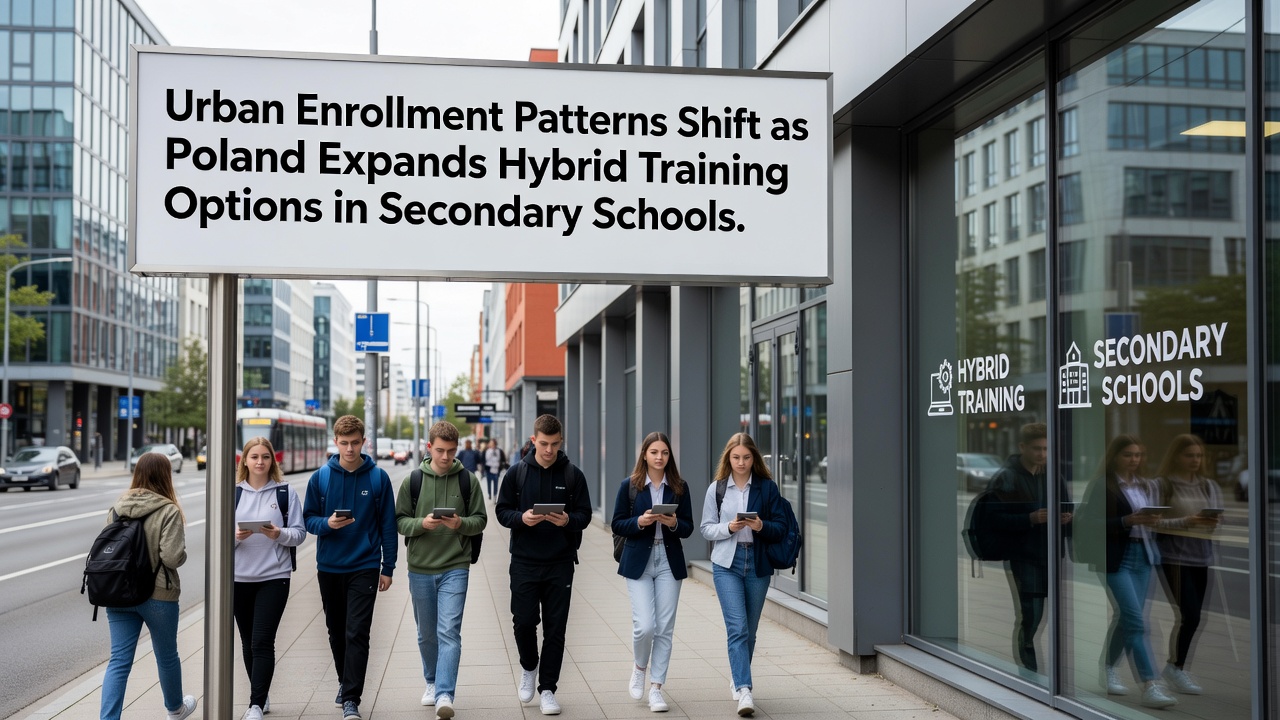
Poland has rolled out expanded hybrid training options across its secondary school system, and urban enrollment patterns have begun to reflect those changes in measurable ways. Government data collected through the 2025-2026 academic year shows that cities such as Warsaw, Krakow, and Wroclaw recorded shifts in how students select and maintain their school placements once blended formats became widely available. Officials implemented the broader rollout in stages, with full availability targeted for October 2026, allowing schools to adjust staffing, technology infrastructure, and scheduling frameworks before the next intake cycle.
Policy Framework Behind the Expansion
The Ministry of National Education coordinated the hybrid initiative by updating curriculum delivery rules so that secondary institutions could combine on-site instruction with remote modules without losing accreditation status. Districts received targeted funding to upgrade digital platforms, train teachers in synchronous online methods, and ensure equitable access for students who split time between home and classroom settings. Researchers tracking implementation noted that urban schools adopted the model more rapidly than rural counterparts, largely because broadband penetration and device availability already stood at higher baseline levels in city environments.
Enrollment Data and Geographic Trends
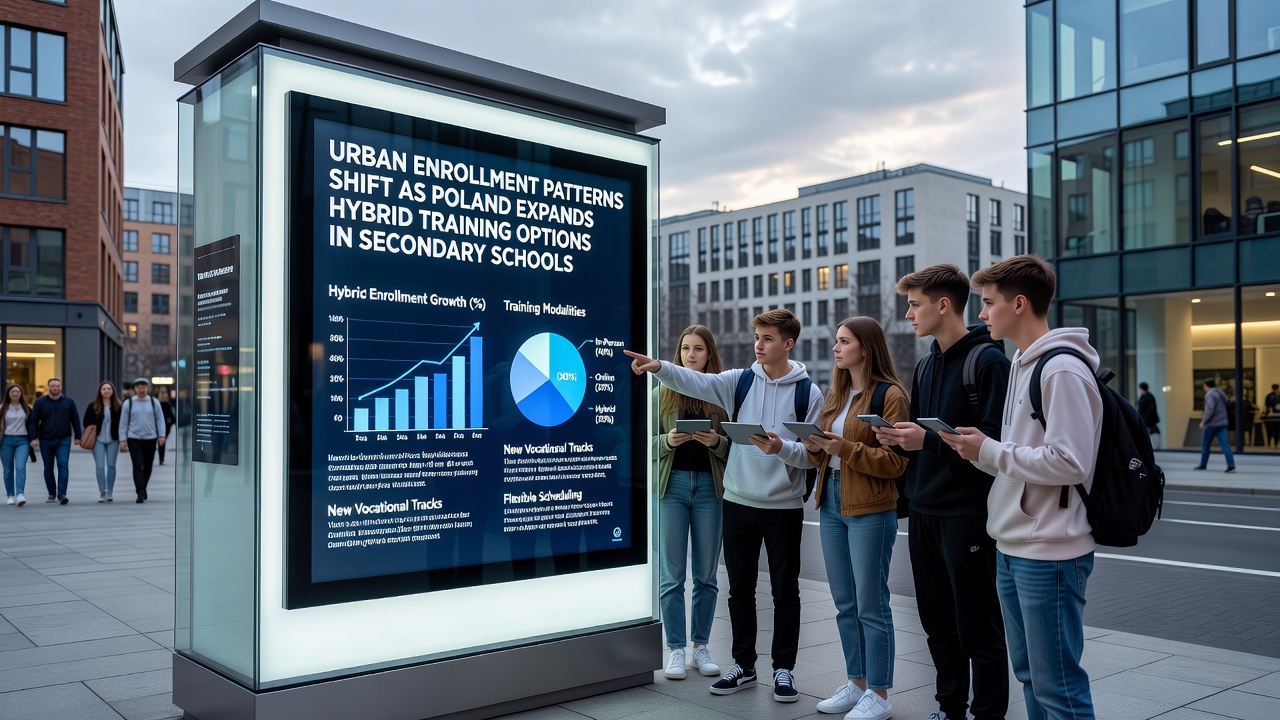
Statistics released by the Central Statistical Office of Poland indicate that urban secondary schools saw a 12 percent increase in applications for hybrid tracks during the most recent enrollment period, while fully in-person tracks experienced a corresponding decline. Observers note that families in metropolitan areas cited scheduling flexibility around extracurricular commitments and part-time work as primary reasons for choosing blended options. In contrast, enrollment stability held steadier in smaller towns where hybrid availability remained limited by infrastructure constraints.
One longitudinal study conducted by Warsaw University researchers followed 4,800 students across ten voivodeships and found that students living within city administrative boundaries were three times more likely to switch from traditional to hybrid enrollment once the option became accessible. The same analysis showed that transportation costs and commuting times dropped for participating urban students, though overall academic performance metrics remained consistent with prior cohorts who studied exclusively on-site.
School-Level Adjustments and Teacher Preparation
Secondary institutions in major cities adjusted daily timetables to accommodate both physical and virtual attendance, often designating specific days for in-person labs and project work while moving lectures and discussions online. Professional development programs reached over 18,000 educators by mid-2026, focusing on digital pedagogy and assessment techniques suited to mixed delivery. Data from the European Commission's education monitoring reports show that Polish secondary teachers reported higher confidence in hybrid instruction after completing these modules compared with pre-expansion surveys.
Yet the transition also surfaced capacity differences among schools. Larger urban campuses with existing IT support teams integrated hybrid tools more smoothly, whereas smaller institutions required additional external assistance to maintain consistent connectivity and student engagement tracking. OECD education indicators for 2025 placed Poland's secondary digital infrastructure investment in the upper quartile among member countries, reflecting sustained budget allocations tied to the hybrid expansion.
Student Outcomes and Regional Comparisons
Initial outcome measures collected through October 2026 indicate that hybrid participants maintained attendance rates comparable to those recorded in fully in-person settings. University admissions offices in several Polish cities reported no measurable difference in application strength between students who completed hybrid versus traditional secondary pathways. Australian education researchers who reviewed similar blended programs in their own system noted parallel patterns, where urban students leveraged flexibility without sacrificing progression rates.
Case examples illustrate the variety of implementation approaches. One technical secondary school in Gdansk introduced rotating cohorts so that half the class attended physically while the other half joined live streams, then reversed the groups the following week. Another institution in Lodz partnered with local businesses to allow hybrid students to complete workplace modules during remote days, aligning school calendars with industry shift patterns.
Conclusion
Poland's expansion of hybrid training options in secondary schools has coincided with measurable changes in urban enrollment patterns, driven by policy updates, infrastructure investments, and shifting family preferences. Data collected through October 2026 continue to inform further refinements, with officials monitoring how these formats affect equity, teacher workload, and long-term student pathways. Continued collection of enrollment and performance statistics will clarify whether the observed urban shifts stabilize or evolve as the system matures.